Ciociaria & Lazio
Ciociaria, Italy: The Region Between Rome and Naples
Ciociaria takes its name from a peasant sandal and has never had official borders. Where it is, what the name means, and what you find there.
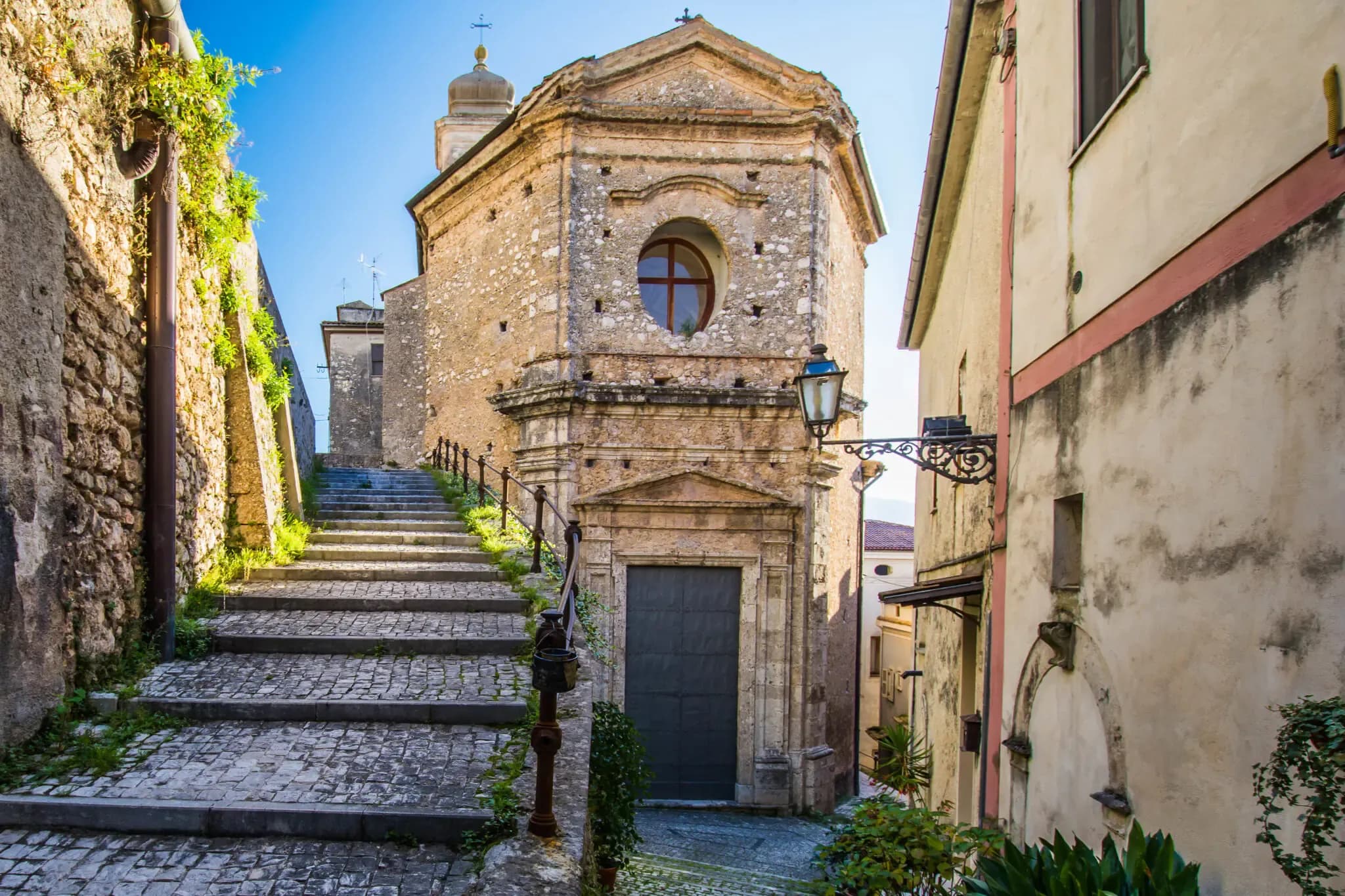
Ciociaria is the hill country of southern Lazio, between Rome and Naples, and it corresponds roughly to today's province of Frosinone. The name is historical, and the area has never had official borders. Frosinone, the provincial capital, is an hour to an hour and a half from Rome by direct regional train, and from there Ciociaria follows the valleys of the Sacco and the Liri southeast toward Cassino.
In Italian the name takes the article, as region names do: la Ciociaria, like il Lazio or la Toscana. A man from here is a ciociaro, a woman a ciociara, and the same word works as an adjective for anything from the area.
What does "Ciociaria" mean in English?
The name comes from the ciocia (plural ciocie), a rustic shoe once worn by farmers and shepherds across central and southern Italy. Treccani, the Italian national encyclopedia, describes it as a rectangle of leather larger than the foot, raised around the sole by straps that pass through holes along its edge and then cross up the lower leg, which was usually wrapped in white cloth. The origin of the word ciocia is uncertain, and Treccani describes Ciociaria as a name of popular use. English has no equivalent. The closest translation of Ciociaria is "the land of the ciocie".
In Rome the word also had other meanings. Treccani records that in the nineteenth century ciociara was used in the city as a synonym for an artist's model or a wet nurse, because so many women from these hills did that work there.
The word also names a novel and a film: Alberto Moravia's La ciociara, published in 1957, and the film Vittorio De Sica made from it in 1960, released in English as Two Women. Sophia Loren won the Academy Award for Best Actress for her role, and the Academy records her as the first performer to win an Oscar for a foreign-language role.
What is the difference between Rome and Lazio?
Lazio is itself a region, one of the 20 listed in the Italian Constitution, in the center of the country on the Tyrrhenian Sea. Rome is its capital. The region is divided into the Metropolitan City of Rome and four provinces, Viterbo, Rieti, Latina and Frosinone, each named after its capital city. The city of Rome alone holds almost half of the region's population, and the Metropolitan City about three quarters.
Ciociaria appears nowhere on this list. It has no government and no official boundary. It is a historical name for an area inside the province of Frosinone, and people still disagree about exactly how much of the province it covers.
Where is Ciociaria, and where does it end?
Treccani defines Ciociaria as a region of southern Lazio without defined borders, corresponding roughly to the province of Frosinone except for its western and southern edges. It lists Frosinone, Anagni, Ferentino, Alatri, Veroli, Ceccano and Sora as the main towns. The province counts 91 municipalities. It takes in almost all of the Sacco basin and the middle valley of the Liri, with the Ernici mountains, the Meta and the Mainarde rising toward Abruzzo on one side and the Lepini and Ausoni ranges on the other.
The uncertainty has a history. The province is a twentieth-century creation. A royal decree of January 2, 1927 created it by joining the district of Frosinone, which had been papal territory until 1870, with 41 towns of the district of Sora and 11 of the district of Gaeta. Those 52 towns came from Terra di Lavoro, a province governed from Caserta that was abolished the same year, and Sora, Cassino and Arpino were among them. For centuries the border between the Papal States and the Kingdom of Naples ran through what is now a single province.
Definitions still differ on that southern side. Treccani includes Sora but leaves the southern edge out, while the Province of Frosinone's own list of the places of Ciociaria includes the abbey of Montecassino, at the southern end of the province. For planning a trip, the whole province is the useful map, and it is the one this guide uses. Seven of its towns, among them Picinisco, Settefrati and San Donato Val di Comino, are part of the National Park of Abruzzo, Lazio and Molise.
What is the Ciociaria dialect?
There is no single dialect, and the old border explains most of the differences. In Treccani's encyclopedia of the Italian language, the linguist Francesco Avolio divides the dialects of Lazio into four types, and two of them meet in the province of Frosinone.
- The "median" type, which Avolio calls Sabine and ciociaro, runs from Amatrice and Rieti down to Anagni. The same family continues outside Lazio, into southeastern Umbria and the area of Macerata and Fermo in the Marche.
- The southern type begins south of the old border between the Papal States and the Kingdom of Naples. Around Cassino the speech is close to Neapolitan, as it is on the coast at Gaeta and Formia. Up the Liri at Sora it is almost Abruzzese, and towns such as Atina, Arce and Pontecorvo sit in between.
A band of towns from Terracina through Frosinone to Guarcino links the two types. Anagni and Cassino, about an hour apart by car, fall on opposite sides of the line.
What is Ciociaria known for?
Walls of fitted stone
Several hill towns are still ringed by walls of huge limestone blocks cut to fit one another without mortar, the technique called polygonal masonry. In Alatri, the town museum describes acropolis walls more than a kilometer long and, on the eastern side, over 15 meters high. The lintel of the Porta Maggiore is a single stone more than 5 meters long, and the Via Gregoriana, a ring road commissioned by Pope Gregory XVI in 1843, lets you walk around the outside of the acropolis. Ferentino, Veroli and Arpino have walls of the same kind. On the acropolis of Civitavecchia, near Arpino, one gate is a pointed arch built of stones stepped inward until they meet.
Popes, Cicero and a legendary slap
Anagni was the capital of the Hernici, an Italic people of these hills, until Rome took the town in 306 BC. It is called the City of the Popes after four popes linked to the town: Innocent III, Gregory IX, Alexander IV and Boniface VIII. Gregory IX and Boniface VIII were born there. On September 7, 1303, Guillaume de Nogaret, a counselor of King Philip IV of France and later his chancellor, and the Roman noble Sciarra Colonna seized Boniface VIII in his palace at Anagni, and the people of the town soon freed him. The episode is known as the slap of Anagni, after a blow the pope is said to have received, which belongs to legend. The crypt of Anagni's cathedral is painted with frescoes from the mid-thirteenth century, one of the most complete cycles of that period.
Arpino is where Cicero was born, on January 3, 106 BC. Gaius Marius, the general, was born at Cereatae, in the territory of ancient Arpinum, and the Cistercian abbey of Casamari, now in the municipality of Veroli, stands on the remains of that Roman town. Its church was begun in 1203 and consecrated by Pope Honorius III in 1217.
At the southern end of the province, Saint Benedict founded Montecassino around 529. Allied bombing almost entirely destroyed the abbey on February 15, 1944, and Pope Paul VI consecrated the rebuilt basilica on October 24, 1964. Our guide to visiting Monte Cassino covers the abbey and the battlefield.
Water
At Isola del Liri, the river splits in two at a castle and one branch drops about 27 meters in the middle of town. Italy's national tourism board describes this Cascata Grande as the only waterfall in the country that falls inside a historic town center. A short drive east, the lake of Posta Fibreno, about 30 hectares of cool, clear spring water, is the center of a regional nature reserve created in 1983. At its southeastern end floats la Rota, an island about 30 meters across made of roots, peat and marsh plants, which drifts with the wind and the flow of the springs.
At the table
Cesanese del Piglio, a red wine made from Cesanese grapes, has been a DOC since 1973 and in 2008 became the first DOCG wine of Lazio. The Valle di Comino makes Pecorino di Picinisco, a raw-milk cheese with protected designation of origin (DOP), and the cannellino beans of Atina and the peppers of Pontecorvo carry the same designation.
Is Ciociaria worth visiting?
For travelers who care more about old towns, food and history than about famous names, yes. The sights also sit close together: Anagni, in the northwest of the province, and Montecassino, in the southeast, are about 80 kilometers apart, roughly an hour by car. Walled towns, a papal city, two abbeys, a waterfall and a spring-fed lake fit into that stretch.
A few practical points:
- Getting there. Direct regional trains from Rome Termini reach Frosinone in about 55 to 90 minutes and Cassino in about an hour and a half to two hours. From Naples, direct trains reach Cassino in a little over two hours.
- Getting around. Alatri, Veroli and the villages of the Valle di Comino have no train station, so a car or a driver makes the difference.
- How long to stay. Three days cover Anagni, Alatri and Montecassino at a brisk pace. A week lets you add the Valle di Comino, Isola del Liri and Posta Fibreno, with time left for long lunches.
If Ciociaria is one part of a longer look at the region, our guide to Lazio beyond Rome covers the hill towns north and east of the capital. If your family came from one of these towns, start with how to find your family's town in Italy.
Seeing Ciociaria slowly
Maria Grazia Nardoianni, who founded Italy Authentica, was born in Cassino. Our Ciociaria destination page gathers what we do here, and Ciociaria, a Name That Sounds Like Earth is the eight-day journey: a morning with a cheesemaker, a village with a waterfall, the waters of Posta Fibreno and a day at Montecassino, with departures in May, July and September 2027 for groups of up to eight. If you prefer to walk the old centers at your own speed, Villages and Slow Walks is the experience built around them.
Related articles
Ciociaria & Lazio
Monte Cassino: How to Visit the Abbey and the Battlefield
Ciociaria & Lazio
Lazio Beyond Rome: Hill Towns Worth the Trip
Ciociaria & Lazio
Beach Towns Near Rome: The Southern Lazio Coast
Sicily
An Eastern Sicily Itinerary: 7 to 10 Days, Slowly
Planning
How to Plan a Trip to Italy: The Questions We Ask First
Food & Wine