Ciociaria & Lazio
Monte Cassino: How to Visit the Abbey and the Battlefield
The abbey above Cassino was founded around 529, bombed in 1944 and rebuilt stone by stone. How to visit it, and the battlefield below, in a single day.
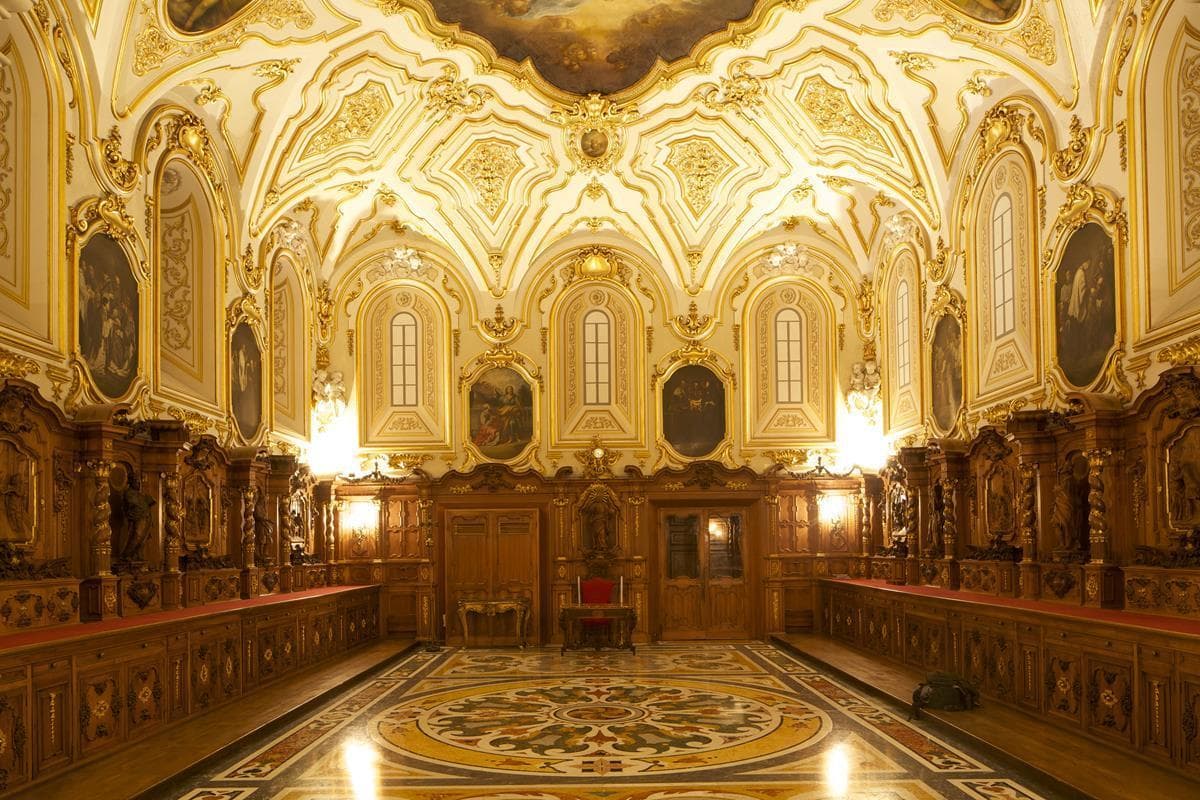
You can see Monte Cassino in one day. The Benedictine abbey on the summit opens daily, and the cemeteries and memorials of the 1944 battle lie on the slopes and in the valley below, a short drive from one another. Start at the abbey in the morning, then go down to the Polish, Commonwealth and German war cemeteries. Monte Cassino rises above the town of Cassino, in southern Lazio, some 130 kilometers (80 miles) southeast of Rome.
Can you visit Monte Cassino?
Yes. As of September 2026, from April 1 to October 31 the abbey is open every day from 9:30 a.m. to 6:30 p.m. From November 1 to March 31 it opens at 9:30 a.m. and closes at 4:50 p.m. from Monday to Saturday and at 5:15 p.m. on Sunday. Sunday Mass is at 10:30 a.m. and at noon, and the 10:30 Mass is sung in Gregorian chant. Visits pause during services, so plan around them, or stay and listen.
The house rules are short. Clothes that are too short or too low-cut are not allowed, and neither are pets. Photos with your phone are fine everywhere. Italy's Ministry of Culture suggests about an hour for the abbey itself, and comfortable shoes.
The museum has its own ticket, €6 for adults as of September 2026, and guided visits are paid and booked separately. The museum keeps the abbey's hours from April to October; from November to March it may open only on Sundays and holidays, so check before you go. Guided visits must be booked ahead and run in Italian, English, French, German, Spanish, Polish and Portuguese. They are the only way into the oldest part of the monastery: the cell of Saint Benedict, the polygonal walls and the Staircase of Epigraphs.
How to get to Monte Cassino from Rome or Naples
By car, leave the A1 motorway at the Cassino exit. Signs lead to the foot of the mountain, and from there the road climbs 8 kilometers (5 miles) to the abbey. The abbey puts the drive at about an hour and a half from Rome's Fiumicino airport and an hour from Naples airport.
By train, direct regional and Intercity trains run from Rome Termini to Cassino in 1 hour 25 minutes to about 2 hours 30 minutes, depending on the train (Trenitalia timetable for October 2026). A local bus climbs from Cassino station to the abbey a few times a day; as of September 2026 the abbey lists departures at 10:00 a.m., 12:35 p.m. and 3:20 p.m., as a guide only. The cemeteries are spread across the valley, and for the full day a car with a driver saves a lot of waiting.
Is Monte Cassino still a monastery?
Yes. A community of Benedictine monks lives here by the Rule that Saint Benedict wrote. The monastery also takes in guests who want to share the community's silence, prayer and meals for a while. Its church is a cathedral. Montecassino is a territorial abbey, a church district equivalent to a diocese; the Vatican's Congregation for Bishops confirmed that status in 2014 for the cathedral, the monastery and the land immediately around it.
What does Monte Cassino mean in English?
It means Mount Cassino, the mountain above the town of Cassino. The Romans called the town Casinum, and until 1863 it was named San Germano. In Italian the abbey is written as one word, Montecassino.
Saint Benedict of Norcia came here from Subiaco around 529 and built his monastery on the summit, where a temple of Apollo had stood. He died here in the middle of the sixth century and shares his tomb with his twin sister, Saint Scholastica. Thomas Aquinas was among the pupils of the monastery's school. The abbey has been destroyed four times: by the Lombards in 577, by Saracen raiders in 883, by an earthquake in 1349 and by Allied bombs on February 15, 1944.
Monte Cassino in WWII: what happened here
By the winter of 1943 the German army had fortified a defensive line south of Rome, the Gustav Line. It ran along the Garigliano and Rapido rivers and was anchored on Monte Cassino, which commands the Liri valley and the road to Rome. Between January and May 1944 the Allies attacked it four times.
Americans fought here from the first battle. On the night of January 20, 1944, two regiments of the 36th Infantry Division, a Texas National Guard unit, tried to cross the Rapido near the village of Sant'Angelo. The crossing failed after 48 hours. The US Army's multivolume official history counts 1,681 killed, wounded and missing in the division's own units, not including the units attached to it. The Army's shorter brochure on the Rome-Arno campaign gives 2,128 casualties for the two regiments. The 34th Infantry Division then crossed the river and fought on the high ground northeast of the town, trying to outflank Cassino and reach the monastery.
In February the commander of the New Zealand Corps, Lieutenant General Sir Bernard Freyberg, concluded that the monastery had to be destroyed and asked for air attacks. General Mark Clark, commander of the US Fifth Army, disagreed and was overruled by his superiors. On February 15, after leaflets warned the civilians inside to leave, American bombers began their runs at 9:45 a.m. The Army's Rome-Arno brochure counts 142 B-17s, 47 B-25s and 40 B-26s dropping 1,150 tons of bombs on the abbey; the multivolume official history puts the weight at almost 600 tons of high explosive and notes that the figures vary. The abbey's own history records that hundreds of Italian civilians sheltering there died, that no German soldiers were found among the dead, and that German troops then moved into the ruins. The monks call the bombing entirely unjustified. The brochure says the decision was widely condemned at the time and since.
Much of what the monks treasured had already gone. In 1943 a German officer, Captain Maximilian Becker, and an Austrian one, Lieutenant Colonel Julius Schlegel, organized with the abbot's consent the transfer of the archives, the art and a library of more than 80,000 volumes to Rome. The last loads left in November.
The town below was destroyed in March. The last offensive, Operation Diadem, opened at 11 p.m. on May 11 with 1,660 guns firing along the front. On May 13 General André Dody's 2nd Moroccan Division, part of the French Expeditionary Corps, broke the Gustav Line at Monte Majo, and on May 17 the Polish II Corps attacked Monte Cassino again.
Who won the Monte Cassino battle?
The Allies. During the night of May 17 the last German defenders withdrew, and on the morning of May 18 soldiers of the Polish II Corps entered the ruins and raised the Polish flag. Rome fell on June 4, 1944. The winning side was a coalition: Americans, men from across the United Kingdom, Canadians, French and North African divisions, Indians, Gurkhas from Nepal, New Zealanders, Poles, South Africans and Italian units fighting with the Allies.
How many British soldiers died at Monte Cassino?
The clearest count comes from the Commonwealth War Graves Commission, which records British and Commonwealth dead together. Cassino War Cemetery holds 4,271 Commonwealth servicemen of the Second World War, 289 of them unidentified, and most of them fell in the first five months of 1944. The Cassino Memorial, at the heart of the cemetery, names some 4,000 more who fought in Sicily and Italy and have no known grave. Minturno War Cemetery, near the Garigliano, holds more than 2,000, mainly men killed crossing that river in January 1944. The graves at Cassino belong to soldiers from Britain, Canada, New Zealand, South Africa and India, among others.
Visiting the Monte Cassino battlefield today
The Polish War Cemetery
Just below the abbey, in the hollow between the monastery and Hill 593, lie more than a thousand soldiers of the Polish II Corps (1,066, according to the Memorial Museum of the 2nd Polish Corps). Many of them had reached Italy from Soviet prisons, by way of Iraq, Palestine and Egypt. The cemetery was consecrated on September 1, 1945, and in 1970 the ashes of their commander, General Władysław Anders, were brought from London and buried among them. One inscription says that the soldiers gave their souls to God, their bodies to the soil of Italy and their hearts to Poland. A memorial room at the entrance tells their journey in Polish, English and Italian, and a Polish monument stands on the top of Hill 593. Poland holds official ceremonies here on May 18, the anniversary of the capture.
Cassino War Cemetery
The Commonwealth cemetery lies just southwest of the town, at the foot of the mountain. The cemetery and the memorial were designed by Louis de Soissons, the Commission's principal architect for Italy. Among the names on the memorial is Second Lieutenant Eric Fletcher Waters of the Royal Fusiliers, killed at Anzio on February 18, 1944, whose body was never recovered. His son Roger, five months old at the time, later became one of the founders of Pink Floyd.
The German war cemetery at Caira
Three kilometers (2 miles) north of Cassino, on a spur of Colle Marino, about 20,100 German soldiers lie on terraces that look down on the valley. They fell at Salerno, along the Adriatic coast and at Cassino. The Volksbund, Germany's war graves commission, brought them here from smaller cemeteries and scattered field graves in 1959 and 1960, and 3,100 graves remained nameless. Each stone cross carries three names on each side. The cemetery was dedicated on May 4, 1965.
The Italian shrine at Mignano Monte Lungo
Italian soldiers of the war of liberation are buried at the military shrine of Mignano Monte Lungo, on the Via Casilina just across the regional border in Campania. On December 8 and 16, 1943, troops of the Italian 1st Motorized Group attacked Monte Lungo with the American II Corps. It was the first combat of regular Italian units against the Germans in the war of liberation. The shrine holds 974 men, and a small museum stands across the road.
The Rapido at Sant'Angelo in Theodice
In the square of Sant'Angelo in Theodice, a hamlet of Cassino, a rose-colored stone obelisk honors the 36th Infantry Division. It looks over the river that the US Army called the Rapido; this stretch is properly the Gari.
The Historiale in Cassino
In town, the Historiale museum opened in 2004, for the 60th anniversary of the battle, to honor the dead of all nations. Its rooms cover the Gustav Line, the bombing of the abbey and the testimony of civilians. Opening hours are short and change with the season, so check before you go.
The American military cemetery for this part of the campaign is the Sicily-Rome American Cemetery at Nettuno, near Anzio. Most of those buried there died in Sicily, at Salerno and in the fighting north toward Rome, or at Anzio. Our guide to the WWII places American families come back to covers it in detail.
Is there anything left of Monte Cassino?
Some of it. The bombing left the monastery in ruins, but several pieces came through. The bronze urn holding the remains of Saint Benedict and Saint Scholastica was not damaged, and an anti-aircraft shell was found, unexploded, among the steps of the high altar. The central bronze door of the cathedral is the original, made in Constantinople for Abbot Desiderius in 1066. Much of the crypt survived with its mosaics, and so did the 18th-century statue of Saint Benedict by Paolo Campi in the cloister, a tabernacle by Nicola Salvi, the architect of the Trevi Fountain, and the marble tomb of Piero de' Medici.
The monastery was rebuilt where it was and as it was under Abbot Ildefonso Rea, and the cathedral follows its 17th- and 18th-century design. Pope Paul VI consecrated the new basilica on October 24, 1964, and on the same day proclaimed Saint Benedict patron of Europe. From the loggia of the Renaissance cloister you look down on the Liri valley and the Polish cemetery.
Is there a film about the Battle of Monte Cassino?
There are at least two feature films. Die grünen Teufel von Monte Cassino (The Green Devils of Monte Cassino) is a West German film directed by Harald Reinl in 1958. Czerwone maki (Red Poppies), written and directed by Krzysztof Łukaszewicz and released in Polish cinemas in April 2024, was presented as the first Polish feature film about the battle. It follows a seventeen-year-old who left the Soviet Union with Anders' army in 1942.
Is it worth visiting Monte Cassino?
If someone in your family fought in Italy, yes. From the abbey you see the Liri valley that the armies fought over for four months, and the graves of both sides are a short drive away. Without a family link, the abbey alone repays the trip, with fifteen centuries of Benedictine history, a Renaissance cloister and a museum of manuscripts, ivories and 18th-century Neapolitan paintings.
Plan a full day. Reach the abbey at opening time, stop at the Polish cemetery on the way down, and spend the afternoon at the Commonwealth and German cemeteries, adding the Rapido memorial if your family's story runs through the 36th Division. The abbey keeps longer hours from April to October. Sunday adds the sung Mass, and May 18 the Polish ceremonies.
Maria Grazia Nardoianni, who founded Italy Authentica, was born in Cassino. Our eight-day journey Ciociaria, a Name That Sounds Like Earth includes a day called The Memory of the Land, and the History & Memory experience gathers the war told at the table, the rebuilt abbey and the cemeteries. For the wider region, start with Ciociaria and our guide to Ciociaria, the region between Rome and Naples. If you are coming for one name and one unit, write to us through design your trip: Maria Grazia reads every request herself.
Related articles
Ciociaria & Lazio
Ciociaria, Italy: The Region Between Rome and Naples
Ciociaria & Lazio
Lazio Beyond Rome: Hill Towns Worth the Trip
Ciociaria & Lazio
Beach Towns Near Rome: The Southern Lazio Coast
Sicily
An Eastern Sicily Itinerary: 7 to 10 Days, Slowly
Planning
How to Plan a Trip to Italy: The Questions We Ask First
Food & Wine