
Roots & Memory
Visiting Your Ancestral Town in Italy: What to Expect
What you will find in the town your family left: a registry office, a parish archive, a cemetery with its own rules, a dialect. How to prepare so the visit counts.
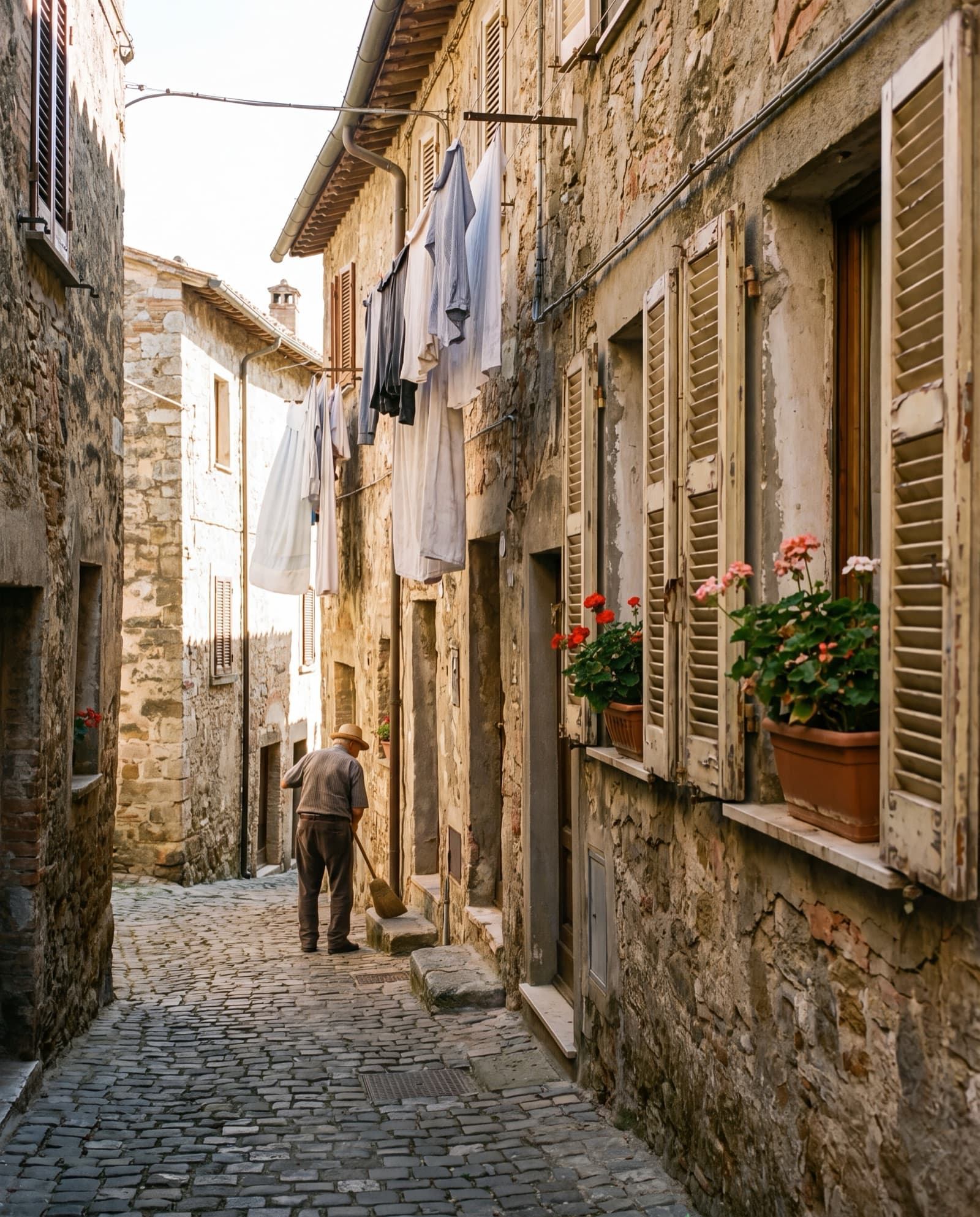
Expect a real, working town: a town hall with a civil registry office, a parish and its archive, a cemetery with rules that may surprise you, a square, and residents who may share your surname without knowing your family. How much of your family's story you find there depends on what you bring: the right town, the Italian form of each name and the records you have already traced. If Italian American Heritage Month has you thinking about a visit, start with the paperwork, because an answer from Italy can take months.
What month is Italian American Heritage Month?
October. Congress designated October 1989 as Italian-American Heritage and Culture Month, and President George H. W. Bush proclaimed it on October 12 of that year, citing the contributions of Italian Americans to business, the arts, education, government, sports and military service. It was proclaimed again in later years, including 1990 and 2010. The Census Bureau marks the month with its own figures: in 2022, about 16 million people, 4.8 percent of the U.S. population, reported Italian ancestry, the fifth most reported ancestry in the country.
Why is June Italian Heritage Month?
June is the Canadian date. On May 17, 2017, the House of Commons in Ottawa adopted a motion to declare June Italian Heritage Month every year. When Deb Schulte, the member of Parliament who sponsored it, introduced the motion in November 2016, she gave two reasons for the choice: Italy celebrates its national day on June 2, and in 2010 Ontario had passed an act proclaiming June as Italian Heritage Month. In Canada's 2021 census, more than 1.5 million people claimed Italian origins.
Which U.S. state has the most Italian ancestry?
New York. In the 2020 Census, 1.1 million New Yorkers identified as Italian alone, and New York and New Jersey together were home to more than a quarter of all the people who did. The county with the largest Italian population was Suffolk County, on Long Island, with 360,345 people. Across the country, 16.8 million people identified as Italian, alone or in combination with other groups.
Before you visit your ancestral town in Italy
Confirm the comune first. Civil records are kept by the town, and your ancestor may have lived in a village that belongs to a larger town nearby. Check whether the town had another name or belonged to another province, as Cassino, once called San Germano, did. If you have not found the town yet, our guide to finding your family's town in Italy explains where to look.
Bring copies of every record you have, with the Italian form of each name: Giuseppe for Joseph, Maria for Mary. Write ahead, in Italian, to the civil registry office and to the parish, with full names, dates and the names of the parents. FamilySearch, whose Italy letter-writing guide includes sample sentences, warns that a reply can take six months or longer.
Why is Italian DNA unique?
According to a 2019 study in Science Advances, migration and mixing have given Italy the largest degree of population structure, meaning genetic differences between regions, detected so far in Europe. A consumer DNA test can suggest a region and connect you with relatives who have tested too. The name of the town comes from the records.
What to expect at the town hall
The comune keeps its own set of the civil registers. A second set went to the local court and, over time, to the State Archive, and that second set is usually the one published online on the Antenati portal of the Italian Ministry of Culture. The portal notes that registry records are held by the comuni and that certificates are requested from them, so the civil registry office, the ufficio di stato civile, is where to ask for one. Images downloaded from Antenati have no legal value: a certified copy of one of those registers comes from the State Archive that holds it.
Ask the comune's population registry, the ufficio anagrafe, about the stato di famiglia storico as well, a historical family record that lists everyone who lived in a household. The office may ask why you need it. FamilySearch notes that not every area kept one, and that some towns stopped following a family once it had emigrated.
The parish and the cemetery
Parish registers of baptisms, marriages and burials go back further than civil ones: most parishes have them from about 1595. Virtually all are still kept by the parish, with some duplicates in the archive of the diocese. Write to the parish priest before you arrive and ask when the registers can be seen.
Italian cemeteries follow a national regulation from 1990. A grave dug in the ground is normally cleared after ten years and reused, and the bones go to the common ossuary unless the family asks to place them in a niche. Private tombs are granted for up to 99 years, renewable. The grave of an ancestor who died a century ago may no longer exist. Look for the family name on the walls of niches and on family chapels, and ask the comune whether burial records survive.
The town may not match the stories
Some towns were rebuilt from the ground up. Cassino, where Italy Authentica's founder was born, is one of them. The town at the foot of Montecassino was razed by aerial bombing on March 15, 1944, a month after the abbey above it. Cassino was decorated with the Gold Medal for Military Valor, and today it is a modern town of about 35,000 people. For the places of that campaign, see our article on World War II in Italy.
Expect dialect, too. In a 2024 survey by ISTAT, Italy's national statistics institute, more than half of the people aged six and over in southern Italy, Sardinia and Abruzzo aside, used dialect at home, alone or mixed with Italian: 64 percent in Calabria, 61.5 percent in Sicily and 61 percent in Campania. Among people aged 65 and over across Italy, 19 percent spoke almost only dialect at home. If you do not speak Italian, arrange for someone who knows the local speech to come with you.
Feast days that crossed the ocean
Some Italian American feasts began as the feast of a single town. In Boston's North End, the Fisherman's Feast, which dates from 1910, is held every August on North and Fleet Streets, in honor of the Madonna del Soccorso of Sciacca, a coastal town with a fishing port in the province of Agrigento. It is still organized by descendants of the Sicilian fishermen who brought the devotion with them. The North End's feast of Saint Agrippina, held for more than a century, celebrates the saint whose body, according to tradition, was carried from Rome to Mineo, a town in the province of Catania.
Maria Grazia Nardoianni, who founded Italy Authentica, lived in Boston and considers the North End one of the most authentic expressions of Italian identity outside Italy. If your family's town has a patron saint, ask the comune or the parish for the date of the feast before you book, and decide whether you want to be there for it.
When to go and how long to stay
Give the town at least one full weekday, when offices are open, and a second day if you can, for the parish, the cemetery and the square. Keep the paperwork away from Italian public holidays: June 2, the national day; August 15, the feast of the Assumption; and, since 2026, October 4, the new national holiday of Saint Francis of Assisi, which falls in Italian American Heritage Month.
An Italian roots trip can center on one town or take in several. On design your trip you tell us when you would like to travel, who is coming and what matters to you. Within seven days you receive a proposal with real names, places and costs, and, if you wish, a 30-minute call in English or Italian to adjust it. If your family came from Ciociaria or from eastern Sicily, our group journeys spend eight days in those areas, with up to eight guests. Maria Grazia, who was born in Cassino and left home at fifteen, reads every request herself. You can read her story on our site.
Related articles
Roots & Memory
WWII in Italy: The Places American Families Come Back To
Roots & Memory
How to Find Your Family's Town in Italy

Ciociaria & Lazio
Monte Cassino: How to Visit the Abbey and the Battlefield
Sicily
An Eastern Sicily Itinerary: 7 to 10 Days, Slowly
Planning
How to Plan a Trip to Italy: The Questions We Ask First
Food & Wine