Food & Wine
Etna Wine: A Guide for American Wine Lovers
What Etna Rosso and Etna Bianco are made of, how they compare with Pinot Noir and Chablis, how to read a contrada on the label, and when to visit the vineyards.
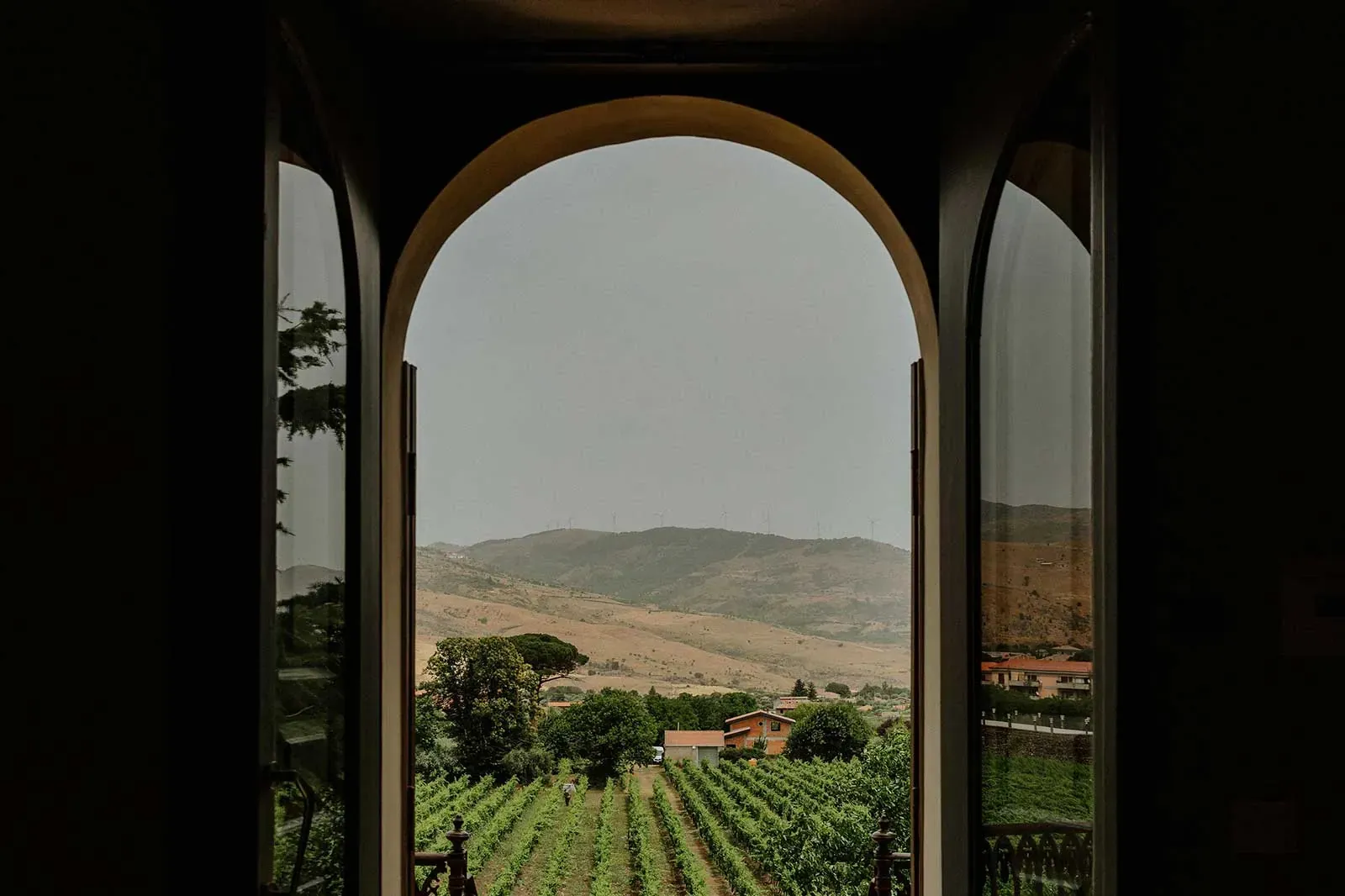
Etna wine comes from the slopes of Mount Etna, the active volcano north of Catania in eastern Sicily, and it is made under the rules of the Etna DOC. The reds, sold as Etna Rosso, are mostly Nerello Mascalese. The whites, sold as Etna Bianco, are mostly Carricante. If you drink Pinot Noir, Barolo, Chablis or dry Riesling at home, you already have a way in: those are the comparisons wine writers reach for most often.
The vines grow mainly between 300 and 900 meters above sea level (about 1,000 to 3,000 feet), and up to 1,100 meters on the southwest side, on soils formed from ash, sand, lapilli and pumice. Etna was the first DOC in Sicily, approved in 1968. Its zone covers parts of 20 towns in the province of Catania and draws a half circle around the volcano, open to the west.
What is an Etna wine?
DOC stands for Denominazione di Origine Controllata, the Italian controlled appellation. Its production rules decide where the grapes may grow, which varieties go into each wine, how long some wines must age and what the label may say. The Etna rules allow these wines:
- Etna Bianco, the white, mostly Carricante.
- Etna Bianco Superiore, a stricter white from a delimited area of Milo, on the eastern slope.
- Etna Rosso, the red, mostly Nerello Mascalese.
- Etna Rosso Riserva, a red aged at least four years.
- Etna Rosato, the rosé, from the same grapes as the red.
- Etna Spumante, a sparkling wine made white or rosé.
In 2025, Etna Rosso made up 42.2 percent of the wine certified under the DOC and Etna Bianco 40.3 percent, according to IRVO, Sicily's regional institute for wine and olive oil. Rosato followed at 8.9 percent. The Bianco Superiore and the Riserva are the rare ones, at 2.8 and 0.6 percent.
Vines have a long record on this mountain. The production rules recall that in the third century BC the Greek poet Theocritus wrote about the vineyards at the foot of Etna, and that between 1880 and 1885 the province of Catania had more than 90,000 hectares of vines, more than any other Sicilian province. Phylloxera, the insect that attacks vine roots, arrived in the early 1900s, and the vineyards fell to about 40,000 hectares. In 2025 the vineyards claimed for the Etna DOC covered 1,449 hectares, about 3,600 acres.
That history is still visible from the road. On steep ground the vines stand on terraces held up by dry walls of black lava stone, among old farmhouses and palmenti, the wide stone basins where grapes were once crushed and left to ferment. The traditional vine is a free-standing bush vine, trained as a goblet. Many old vineyards were never grafted: they grow on their own roots instead of on American rootstock.
Etna Rosso and Nerello Mascalese
Etna Rosso must be at least 80 percent Nerello Mascalese. Up to 20 percent can be Nerello Cappuccio, which the rules also call Nerello Mantellato, and a small share of other grapes is allowed. Etna Rosato follows the same rule. A Riserva must age at least four years, at least 12 months of them in wood, counted from November 1 of the harvest year.
The name Nerello Mascalese points to the old County of Mascali, on the eastern side of the volcano, which the rules call the probable place of origin, or at least of spread, of the grape. Nerello Cappuccio is the minor partner: the more of it in the blend, the deeper the color and the earthier the wine. The rules describe Etna Rosso as ruby red, taking on garnet tones with age.
Is Etna Rosso similar to Pinot Noir?
In color and aroma, yes, and it is the comparison you will hear most often. Like Pinot Noir, Nerello Mascalese gives a pale red with a lot of perfume: red fruit first, then spice and dried herbs. The difference is in the structure: Nerello Mascalese carries more tannin than its pale color suggests, which is why Nebbiolo, the grape of Barolo, usually comes up in the same sentence.
If red Burgundy or Oregon Pinot Noir is your usual bottle, start with a young Etna Rosso. If you drink Barolo, look for a Riserva, and expect to search for it: it was 0.6 percent of the DOC's wine in 2025.
Etna Bianco and Carricante
Etna Bianco must be at least 60 percent Carricante, with up to 40 percent Catarratto and a small share of other non-aromatic white grapes. Etna Bianco Superiore raises Carricante to at least 80 percent, and its grapes must come from a delimited area in the town of Milo, on the eastern slope. It is the only Etna wine tied to a single town.
Carricante probably takes its name from the growers of Viagrande, who valued it for its heavy and steady crops, according to the production rules. On Etna it is planted even higher than Nerello Mascalese. The rules describe Etna Bianco as straw yellow, dry and fresh, and the Superiore as a very pale straw color with green reflections.
What is Etna Bianco similar to?
Wine educators describe Etna Bianco as something between Riesling and Chablis: dry, with lemon and lime notes and a firm mineral line. Carricante can also develop a petrol aroma after several years in bottle, as Riesling does. If Chablis or dry Riesling is what you order at home, start with an Etna Bianco, then taste a Bianco Superiore from Milo next to it.
In April 2026 the Etna DOC consortium reported that the American market accounts for more than a third of its producers' revenue, with the clearest growth in whites and sparkling wines.
What are some famous wines from the Etna region?
The best known are the two main types, Etna Rosso and Etna Bianco, which together made up more than 80 percent of the DOC's wine in 2025. Three others are worth asking for by name:
- Etna Bianco Superiore, from Milo.
- Etna Rosso Riserva, aged at least four years.
- Etna Spumante, at least 80 percent Nerello Mascalese, made white or rosé. The rules allow only a second fermentation in the bottle, the classic method used in Champagne, with at least 18 months on the lees. More than 2,000 hectoliters were made in 2025, close to double the 2022 figure.
Beyond the type, many labels add the name of a contrada, and that name tells you the most about where the grapes grew.
How to read a contrada on an Etna label
Since 2011 the rules have allowed the name of a contrada, a named rural district, to follow the word Etna on the label. The official list has 133 of them, and the producers' consortium describes them as districts that mirror the particular character of their soils. The soils change with the slope and the altitude, and the contrade are meant to capture those differences.
Castiglione di Sicilia has 46 contrade, Randazzo 25, Zafferana Etnea 20, Linguaglossa 10, Trecastagni and Viagrande 9 each, Milo 8, Biancavilla 5 and Santa Maria di Licodia 1. On a label you might read Etna Rosso followed by Santo Spirito or Rampante, two contrade of Castiglione di Sicilia, or an Etna Bianco from Caselle, in Milo. Every Etna DOC wine must also show its vintage, except sparkling wine made without one.
The slope matters as much as the contrada. The production rules describe the sides of the mountain this way:
- North (Randazzo, Castiglione di Sicilia, Linguaglossa): the most rain, up to about 1,200 millimeters (47 inches) a year on the north and northeast sides, and wide swings between day and night.
- East (Giarre, Santa Venerina): the earliest to ripen, because of its exposure and a coastal breeze that keeps summer highs in check.
- South (Santa Maria di Licodia, Biancavilla, Ragalna, Belpasso): strong daily temperature swings and a later harvest. The southwest is the driest side, with about 600 millimeters (24 inches) of rain, and there the vines climb to 1,100 meters (3,600 feet).
Are Etna wines good?
Taste is personal, but demand can be measured. Between 2012 and 2025 the volume of certified Etna DOC wine grew from 9,426 to 46,152 hectoliters, according to IRVO, roughly the equivalent of six million standard bottles. Over the same years the number of growers claiming grapes for the DOC went from 202 to 509.
Etna is still a DOC. In November 2023 the producers' consortium voted unanimously to apply for DOCG, the top tier of Italian wine law, and as of September 2026 the new status had not yet been granted.
Which winery on Etna is considered the best?
The DOC rules rank no producers. What they list are places, the contrade, and this guide does not name wineries either. Most holdings are small: in 2025 the 1,449 hectares of the DOC were shared among 509 growers, under three hectares each on average. The contrada, the slope and the vintage printed on the label tell you more about a bottle than any list. A useful test at a tasting is to try the same grape from two slopes, or a red and a white from the same contrada.
How to visit Etna wineries
Etna is the last area in Sicily to ripen. Grapes for sparkling wine are picked from September, Carricante from about the end of September to mid-October, and the two Nerello grapes from the first ten days of October. On the highest vineyards picking can run to the end of October, and sometimes into November. During those weeks growers are in the vineyards, so book tastings well ahead if you travel then.
The north slope holds most of the contrade: Castiglione di Sicilia, Randazzo and Linguaglossa account for 81 of the 133. From Taormina, Castiglione di Sicilia is about 35 kilometers (22 miles) away, around 40 minutes by car. For a Bianco Superiore, the place to go is Milo, on the eastern slope. Two wineries in a day is plenty, and plan on a driver if you will be tasting.
If you also want to walk on the volcano, read our guide to visiting Mount Etna first, because access to the upper slopes depends on the volcano's activity. For the dishes these wines are poured with, see what to eat in eastern Sicily.
In our Amber Sicily and Sicily, the Magic of Jasmine journeys, the Etna & Wine day is spent on the volcano and with its wines, in groups of up to eight guests. The Table and Vineyard experience is a lunch among the vines with the family that farms them.
Related articles
Food & Wine
What to Eat in Eastern Sicily, Season by Season
Food & Wine
Catania's Fish Market and Street Food
Ciociaria & Lazio
Monte Cassino: How to Visit the Abbey and the Battlefield
Sicily
An Eastern Sicily Itinerary: 7 to 10 Days, Slowly
Planning
How to Plan a Trip to Italy: The Questions We Ask First
Ciociaria & Lazio