Food & Wine
Catania's Fish Market and Street Food
As of 2026, La Pescheria, Catania's fish market, works below the cathedral square every morning except Sunday. Where it is, when to go, what is on the stalls, and the street food nearby.
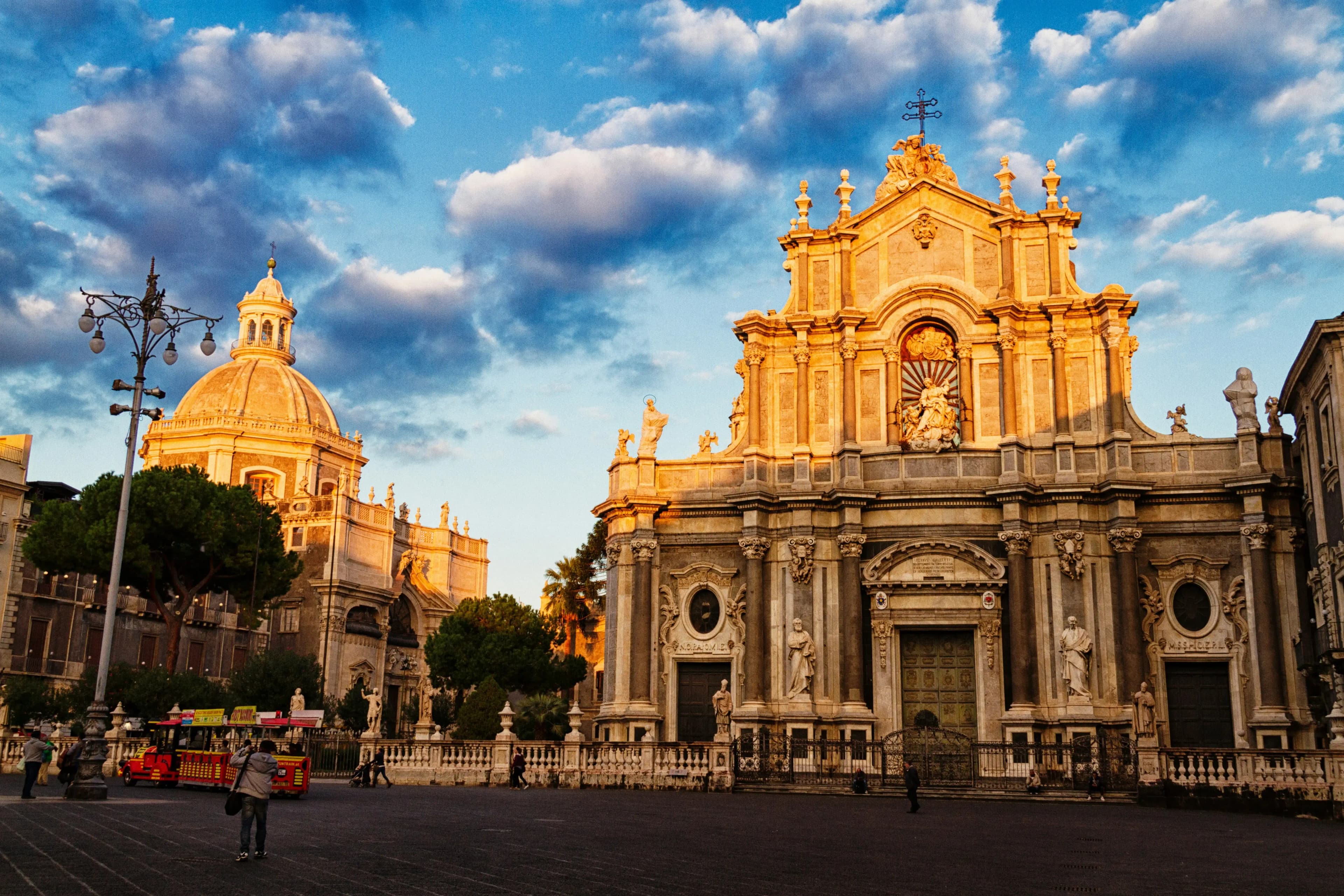
The Catania fish market, La Pescheria (a Piscarìa in Sicilian), fills two squares and an old gallery just below Piazza del Duomo, down a flight of lava-stone steps behind the Fontana dell'Amenano. As of 2026 it works Monday to Saturday from about 7 a.m. to 2 p.m., and it is closed on Sundays and public holidays. Go early for room to look: after 1 p.m. the stalls come down and the cleaners move in.
The street food around it runs from pointed arancini and fried half-moons of dough to horse meat grilled over coals on Via Plebiscito, with a glass of seltz from a kiosk to finish.
Where is the Catania fish market?
The Pescheria of Catania starts at the south side of Piazza del Duomo, the cathedral square, where the city keeps its symbol: the Fontana dell'Elefante, a black basalt elephant carrying an obelisk, designed by Giovanni Battista Vaccarini between 1735 and 1737 and known to the Catanese as u Liotru. Behind the Fontana dell'Amenano, a marble fountain of 1867 next to the Palazzo del Seminario dei Chierici, a lava-stone staircase leads down to the market. The fountain stands for the Amenano, a river that now runs underground beneath the city. Its water spills over the basin like a sheet, which is why the Catanese call the fountain acqua a linzolu, "bedsheet water," and falls into the river itself, about two meters below the square.
Below the steps, the stalls spread through Piazza Alonzo di Benedetto and Piazza Pardo as far as the Archi della Marina on Via Cardinale Dusmet. Fish has been sold on this spot since the early nineteenth century: in 1814 a gallery for the fish market was dug into the embankment of the city walls built in the sixteenth century under Charles V.
When to go: days and hours
As of 2026, the Pescheria keeps these hours:
- Monday to Saturday, from about 7 a.m. to 2 p.m.
- Closed on Sundays and public holidays.
- After 1 p.m. the vendors pack up and the squares are cleaned.
The first hours of the morning are calmer, with the counters freshly laid out; the crowd thickens later. Treat the times as approximate and check ahead around public holidays.
What is on the stalls
The large marble counters stand under the gallery and in Piazza Pardo. At each one, someone is slicing, cleaning, arranging the catch or noting the takings on a scrap of paper. Smaller stands with the day's catch set up in the little square behind the fountain, and toward Via Zappalà Gemelli the stalls turn to meat, fruit and vegetables.
The fish is what the Ionian coast brings in: swordfish, sea bass, red mullet, sea bream, octopus, cuttlefish, squid, red shrimp, clams, mussels, oysters, sea urchins, and anchovies and other oily fish. From April to July, look for masculini, the anchovies of the Gulf of Catania. Those caught at night with the tratta, a drift net whose mesh traps the fish by the head, are a Slow Food Presidium, and they are sold fresh here, in Piazza Pardo. Others are salted, and Catania's fishers invented a preserve of their own: anchovy pieces and the heads caught in the net, which their families packed under olive oil in small terracotta jars called cugnitti.
Listen, too. Vendors call out their wares and prices, a practice the Catanese call the vuciata. Overhead hangs a string of lights spelling out "W Sant'Agata," for the city's patron saint, and underfoot the ice melting off the counters runs into pink puddles.
How to walk through the Pescheria
- Wear closed shoes you do not mind getting wet.
- Go in the first hours if you want the full choice and room to move.
- Ask before you photograph a vendor or a stall.
- Stay for a bite. Around the squares you can eat fried fish, often served in a paper cone called a coppo, and in Catania sea urchins are eaten raw with a squeeze of lemon. At the table, the market's cuttlefish turns up in pasta cco niuru, pasta with cuttlefish ink.
The Fera 'o Luni, Catania's other market
Catania's other historic market, the Fera 'o Luni, fills Piazza Carlo Alberto, Piazza Stesicoro and the streets around them in the morning, usually from Monday to Saturday; check before you go, especially around public holidays. The name is popularly taken to mean "Monday fair," perhaps because the market was once held only on Mondays; it moved to Piazza Carlo Alberto at the end of the nineteenth century. Today it sells vegetables, cheese, cured meats, cooked food, flowers, clothes and toys, beside the Santuario della Madonna del Carmine, which stands on the east side of the square. A few butchers still make zuzzu, a pork jelly that is now hard to find, and it may turn up here or in the Pescheria.
Catania street food: what to eat
Much of Catania's street food comes from the tavola calda counters of bars and bakeries, from the grills of Via Plebiscito and from the kiosks.
- Arancino. In Catania the rice ball is masculine and often pointed, a shape that the Accademia della Crusca, Italy's language academy, says may be inspired by Etna. The classic filling is ragù.
- Cipollina and cartocciata. The cipollina is puff pastry filled with onion, tomato sauce, mozzarella and ham. The cartocciata is a soft, thick dough folded over a filling of ham, mozzarella and tomato, sometimes with olives. Both are usually baked.
- Siciliana. A half-moon of dough filled with tuma or pepato cheese and anchovies, then fried.
- Pizzetta. A small round of dough with tomato, mozzarella and a black olive in the center.
- Horse meat on Via Plebiscito. Along this old street, grills cook horse meat over coals, especially in the evening: sliced thin, as meatballs or in a sandwich. The custom is called arrusti e mangia, "roast and eat."
- Granita with brioche. In Catania some flavors are made with milk, which gives a texture closer to gelato, and the custom is to have granita with whipped cream and a fresh brioche.
- Seltz, limone e sale. At the liberty-style kiosks, the classic order is soda water with lemon juice and a pinch of salt, drunk in the heat of the day and at its end.
For a sit-down plate, Catania's signature dish is pasta alla Norma: pasta with tomato, fried eggplant, ricotta salata and basil. The name is usually read as a nod to Norma, the opera by Vincenzo Bellini, who was born in Catania in 1801, though its origin is uncertain.
For the sweets of the year, from Saint Agatha's minne in February to the frutta martorana of November, see our guide to what to eat in eastern Sicily, season by season.
What are some popular Sicilian snack foods?
At village fairs and patron saint festivals, stalls sell calia e simenza, toasted chickpeas and salted pumpkin seeds, in paper cones. Granita also works as a snack at any hour: Sicily's official tourism site notes that it is eaten at breakfast, at lunch, in the afternoon and even at dinner.
Planning a morning in Catania
- Allow an hour or two for the Pescheria and the cathedral square, and another hour if you add the Fera 'o Luni.
- Come on a weekday or a Saturday morning. There is no market on Sundays.
- If you land at Catania and are heading on to Taormina, our guide to getting from Catania airport to Taormina lists the options.
On Amber Sicily, Catania is the last full day: the fish market, the historic streets and the workshop of a puppet maker. Sicilian puppet theater, the Opera dei pupi, has two main schools, in Palermo and in Catania, and it has been on UNESCO's list of intangible cultural heritage since 2008. The journey leaves in April and October 2027. For more markets, see the Markets & Street Life experience.
Related articles
Food & Wine
Etna Wine: A Guide for American Wine Lovers
Food & Wine
What to Eat in Eastern Sicily, Season by Season
Ciociaria & Lazio
Monte Cassino: How to Visit the Abbey and the Battlefield
Sicily
An Eastern Sicily Itinerary: 7 to 10 Days, Slowly
Planning
How to Plan a Trip to Italy: The Questions We Ask First
Ciociaria & Lazio